
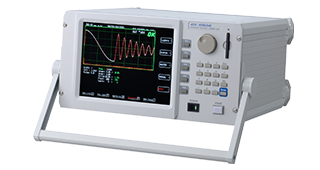
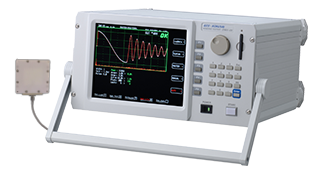
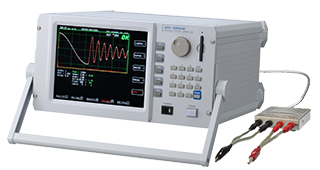
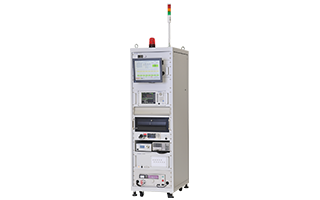
Introduction to the Vpeak Stability Judgment Method
The newly added Vpeak Stability Judgment (Pkstb) for the DWIT Series measures the amplitude based on the peak voltage values of the self-resonance waveform and evaluates changes and disturbances in the vertical-axis direction of the waveform.
■ What Is Vpeak Stability Judgment?
When a high-voltage pulse is applied to a coil, a unique resonance waveform is generated that oscillates while gradually decaying. Vpeak Stability Judgment measures the amplitude based on the peak voltage (V) of this damped oscillation waveform.
Because the peak voltage changes due to waveform distortion and disturbances caused by discharge, losses occurring in the test subject—such as energy consumption and discharge noise—are clearly reflected.
Vpeak Stability Judgment measures the peak voltage of the self-resonance waveform within the specified range and determines pass or fail by comparing it with the master waveform.
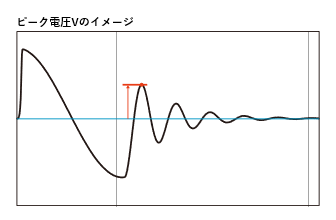
| (Test waveform peak voltage value − Master waveform peak voltage value) | × 100 [%] |
| Master waveform peak voltage value |
If the calculated value falls outside the preset allowable limit (set value), the result is judged as NG (fail).
■ Differences from Other Judgment Methods
Area Judgment compares the overall “area” of the waveform or the “difference area.”
◆ Difference from Frequency Judgment
Frequency Judgment evaluates the “horizontal displacement” of the waveform, such as differences in frequency and period.
■ What Types of Defects Can Be Detected?
◆ Detection of waveform deformation and disturbances caused by discharge or noise
◆ Detection of energy losses caused by defects in core material characteristics or changes in winding conditions