
Introduction to Logarithmic Decrement Judgment
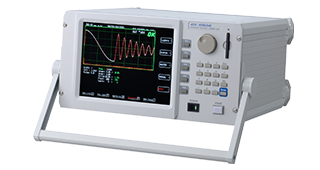
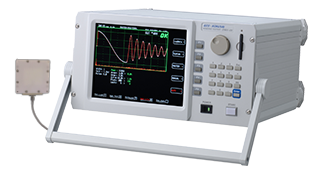
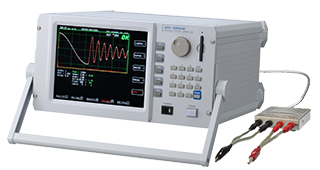
The impulse winding tester DWIT-05 incorporates 12-bit high resolution and 300 MHz high-speed sampling technology to capture subtle waveform changes that were difficult to detect with conventional testers. As one of its new judgment criteria, Logarithmic Decrement Judgment is an innovative method for evaluating coil quality in greater detail based on its physical characteristics.
■ What Is Logarithmic Decrement Judgment?
Logarithmic Decrement Judgment (Ldmp Judgment) is a method that quantifies and evaluates the degree to which the amplitude of the self-resonance waveform generated in a coil after an impulse voltage is applied decreases over time.
The electromagnetic oscillation of a coil gradually decays because energy is consumed by loss factors such as winding resistance and the magnetic resistance of the core material. This damping behavior is expressed by the Q factor (Q value). By directly measuring the way in which the oscillation decays, Ldmp Judgment can sensitively detect changes in the inductance and capacitance components of the test subject, as well as the presence of losses.
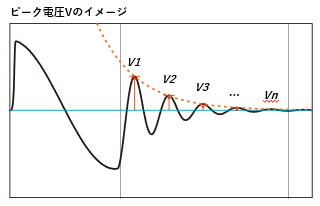
In this judgment method, the average logarithmic decrement (δ) calculated from the peak voltages within the judgment range is compared between the master waveform and the test waveform, and the difference is calculated as a percentage (%).
| (Logarithmic decrement of test waveform − Logarithmic decrement of master waveform) | × 100 [%] |
| Logarithmic decrement of master waveform |
If the calculated value exceeds the preset allowable range (upper and lower limits), the result is judged as NG (fail).
■ Differences from Other Judgment Methods
Compared with conventional judgment methods, Ldmp Judgment has the following features.
Area Judgment compares the area (integral value) of the waveform within a specified range, whereas Ldmp Judgment evaluates the way the waveform “shrinks,” or its rate of decay. It is suitable for detecting subtle changes in energy loss that may be overlooked by area comparison.
◆ Difference from Frequency Judgment
Frequency Judgment measures the period of the waveform (horizontal displacement) and evaluates changes in inductance and stray capacitance. In contrast, Ldmp Judgment focuses on the decay of the amplitude (vertical attenuation) rather than the period.
◆ Difference from Q Damping Judgment
Qdmp Judgment is also a type of area comparison. It automatically adjusts the comparison range based on the waveform peaks or zero-crossing points and then compares the areas. Ldmp Judgment differs in that it directly calculates the physical “attenuation rate” rather than comparing areas.
■ What Types of Defects Can Be Detected?
Ldmp Judgment is particularly effective at detecting waveform changes caused by the following factors.
When a short circuit occurs inside a coil, a closed loop is formed and energy loss increases, causing the waveform to decay more rapidly.
◆ Differences or Defects in the Core Material (Magnetic Material)
Differences in the material or condition of the core change its magnetic resistance and losses, which affects the decaying waveform.
◆ Changes in Inductance or Capacitance Components
Incorrect numbers of winding turns and subtle changes in stray capacitance (C component) can be detected as differences in the decay behavior of the waveform.
By extracting feature values related to these physical characteristics, it becomes possible to screen high-quality winding products that are difficult to distinguish using conventional area comparison alone.