
Frequency Judgment: An Introduction to the Evaluation Method
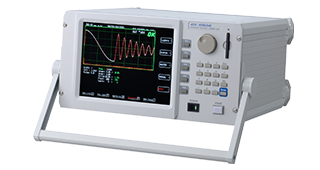
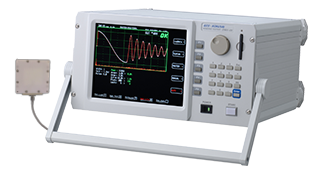
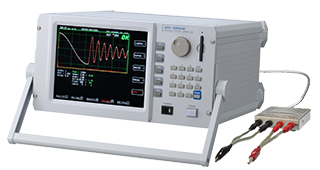
The newly added Frequency Judgment function for the DWIT Series numerically evaluates the resonance frequency as an actual measured value (Hz). It is a judgment method that evaluates the amount of horizontal displacement in the waveform based on frequency.
We will explain this function in an easy-to-understand manner, even for those without specialized knowledge.
■ What Is Frequency Judgment?
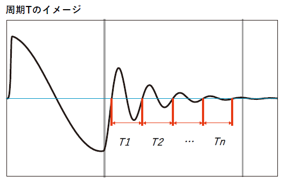
When a high-voltage pulse is applied to a coil, the interaction between the coil’s inductance (L) and the distributed capacitance (C) between the windings generates an electrical oscillation unique to the coil—a damped oscillation. The “speed” of this oscillation is called the resonance frequency, expressed in hertz (Hz).
Coils with the same structure and the same number of turns will always exhibit a constant resonance frequency.
With Frequency Judgment, the average resonance frequency is calculated from the zero-crossing points within the judgment range, and pass/fail is determined using the formula below. In addition, the frequency during the first cycle after the impulse voltage is applied, as well as the average frequency over a specified interval, can be obtained as actual measured values.
| (Test waveform frequency − Master waveform frequency) | × 100 [%] |
| Master waveform frequency |
If this judgment value exceeds the preset limit, the result is judged as NG (fail).
■ Differences from Other Judgment Methods
While Area Judgment and Dif-A Judgment compare the waveform shape (area), Frequency Judgment evaluates changes in inductance (L) and distributed capacitance (C) using the actual measured value of resonance frequency (Hz).
It is effective for detecting differences in the number of turns, core displacement, and coil shape defects.
■ What Types of Defects Can Be Detected?
A partial short circuit between turns or an incorrect number of turns causes the resonance frequency to change. Frequency Judgment captures this change numerically and judges the result as NG when it exceeds the preset limit.